Septic Compliance Inspections in Scott & Dakota Counties, MN
A compliance inspection is the official verdict on whether your septic system protects groundwater and public health — and at a Dakota County closing, it is required paperwork. We match sellers, buyers, and permit applicants with MPCA-certified inspectors who produce county-ready certificates or notices.
What the work involves
What an inspector actually examines
A compliance inspection is narrower and more specific than most people expect. Working under Minnesota rules, the inspector determines whether the system is failing or an imminent threat: Is sewage surfacing or backing up? Is the tank watertight? Is there enough vertical separation between the bottom of the soil treatment area and seasonal high water or bedrock? For existing systems, the inspection does not re-judge system size, setbacks, or how the system was used in the past.
Dakota County: inspection is part of the sale
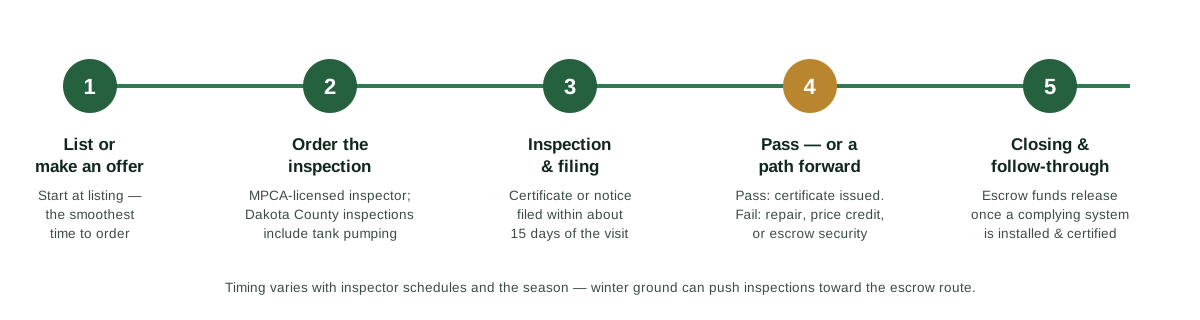
Ordinance 113 requires a compliance inspection report, completed by an MPCA-licensed compliance inspector, for the transfer or sale of every property served by a septic system. Dakota County inspections include pumping the tank to confirm watertightness; a watertightness certification signed by a licensed maintainer within the last three years can satisfy that piece. If the seller cannot provide a certificate of compliance by transfer, the ordinance calls for an escrow agreement giving the buyer security that a complying system will be installed.
Scott County: triggers, not transactions
Scott County Ordinance No. 4 requires compliance inspections in a different set of situations: new or replacement systems, permits or variances to alter an existing system, bedroom additions and certain building permits, changes in property use, and land divisions or splits. A home sale by itself is not on the county list — but Minnesota law still requires the seller to disclose the septic system in writing, some cities add their own requirements, and lenders frequently order inspections anyway. Knowing which rule applies to your address is the first deliverable.
The result is a document, and the document has a clock
The inspector files either a certificate of compliance or a notice of noncompliance, typically within 15 days of the inspection. A certificate for an existing system is generally valid for three years. A notice starts correction deadlines that vary by county and by finding, from 30 days for an imminent threat in Dakota County to multi-year schedules in low-risk Scott County settings. Either document becomes part of the property record your transaction relies on.
How a transfer inspection unfolds
For a Dakota County sale — the most deadline-driven inspection we match — the whole process compresses into five steps. The same visual guide appears in our Dakota County compliance guide, which also covers the Scott County comparison.
Signs you may need this service
- You are selling a Dakota County home served by a septic system
- You are buying and your lender requires a compliance inspection
- Your existing certificate is older than three years
- You are adding a bedroom, an addition, or an accessory structure
- You are splitting or subdividing land with an existing system
- A county notice has asked you to document your system status
Any one of these is a reason to get a licensed professional on site. Septic problems rarely fix themselves, and the cheapest time to deal with one is before it becomes a backup, a failed inspection, or a closing condition.
How the project runs
- Site evaluation. A certified evaluator looks at your lot, locates setbacks from wells, water, and buildings, and digs soil borings to find suitable treatment area.
- Design. A certified designer sizes the system to your home and soils and produces the drawings and specifications the county permit requires.
- Permit. The design is submitted to Scott County or Dakota County (or your city, where it administers the program) and a construction permit is issued.
- Installation. A licensed installer builds the system to the approved design, with county inspection of the work before it is covered.
- County inspection and records. The finished system is inspected, as-built records are filed, and you receive the documentation future buyers and permit applications will ask for.
Cost snapshot
The inspection fee itself is modest next to the work it can trigger. Expect a few hundred dollars for a straightforward property, more when pumping, tank location, or winter access complicates the visit. The real financial question a compliance inspection answers is whether a five-figure replacement is in your future, which is why timing it before you list or offer matters.
| Planning range | What drives it |
|---|---|
| $300 – $800 typical | Soil type and water table, system size and type, tank and pump requirements, lot access, permit and design fees |
Where we match this service
Elko New Market
Septic projects across the city outskirts and surrounding Scott County township acreage.
New Prague
Septic projects on the fringe of New Prague and in its surrounding townships, in both Scott and Le Sueur Counties.
Questions about septic compliance inspections
Who is allowed to perform a compliance inspection?
In Minnesota, compliance inspections must be performed by an MPCA-certified inspector working under a licensed SSTS inspection business, or by a qualified employee of the local government running the program. A home inspector, a pumper, or the installer who wants to sell you a replacement cannot substitute. We match inspection requests to properly credentialed inspectors for exactly this reason.
How much does a compliance inspection cost?
Inspections in the metro exurbs commonly run a few hundred dollars, and Dakota County inspections include pumping the tank to verify watertightness, which adds cost if the tank has not been pumped recently. Complex properties, hard-to-locate tanks, and winter conditions can raise the price. Your matched inspector will quote the inspection itself in writing before scheduling.
How long is a certificate of compliance good for?
Under Minnesota rules, a certificate of compliance for an existing system is generally valid for three years, and for a new system for five years, assuming no evidence of noncompliance appears in the meantime. Dakota County inspections also rely on a watertight tank certification less than three years old. If you are selling, check the date on any existing certificate before ordering a new inspection.
What if my system fails the inspection?
You receive a notice of noncompliance stating what failed and why. From there the paths are repair or replacement on the county's schedule, or, in a Dakota County sale, an escrow agreement that lets the closing proceed while guaranteeing a complying system gets installed. A failure is a problem to manage, not the end of a sale — most failed systems in a transaction are handled by one of those routes.
Should I order the inspection before listing my home?
In Dakota County, almost always yes. The inspection is required for the transfer, inspectors book out during the spring and summer selling season, and knowing your status early lets you price, repair, or plan escrow before a buyer is involved. In Scott County, where a sale alone does not trigger the county inspection, a voluntary inspection still removes the biggest unknown buyers and lenders worry about.
Request a free septic compliance inspections quote
Scott County Septic is a matching service, not a contractor. Your request goes to one independent, MPCA-licensed local installer — never to a call list.
Request received — thank you.
Your matched installer will review your details and contact you about next steps.