Septic System Installation in Scott County, MN
A new septic system is a design project first and a digging project second. We match builders and lot owners in Scott and Dakota Counties with one MPCA-licensed installer who handles the sequence — evaluation, design, permit, installation, inspection — and prices it in writing before anyone breaks ground.
What the work involves
It starts with the soil, not the tank
Every installation begins with a site evaluation. A certified evaluator digs soil borings in the proposed treatment area, checks texture and drainage, finds the depth to seasonal high water and bedrock, and maps setbacks from your well, buildings, property lines, and any water. Those facts, not preference, decide the system type. Good soils at the right depth can take a conventional trench or bed system. Shallow soils, clay, or a high water table push the design toward a mound or an advanced treatment unit.
Design turns findings into a permit-ready plan
A certified designer converts the evaluation into a sized, drawn system: tank capacity based on bedroom count, soil treatment area, distribution method, pump or gravity flow, and a required alternate site kept in reserve. Minnesota rules require the design to protect that second site too, because the first field will not last forever. A complete design is what the county reviews, so gaps here become delays there.
Permitting runs through the county or city
Scott County administers septic permitting under its Ordinance No. 4 across most of the county, and Dakota County under Ordinance 113; a few cities run their own programs. The permit review checks the design against state rules and local standards, including tank sizing and setbacks. Work cannot legally start before the permit issues, and building a system without one can force it to be uncovered or removed.
Installation is licensed, inspected work
A licensed installer excavates, sets tanks, builds the soil treatment area exactly to the approved drawings, and calls for county inspection before anything is covered. In Dakota County this work may only be done by MPCA-licensed professionals. When the inspection passes and records are filed, you receive documentation that matters later at resale, refinancing, and addition permits.
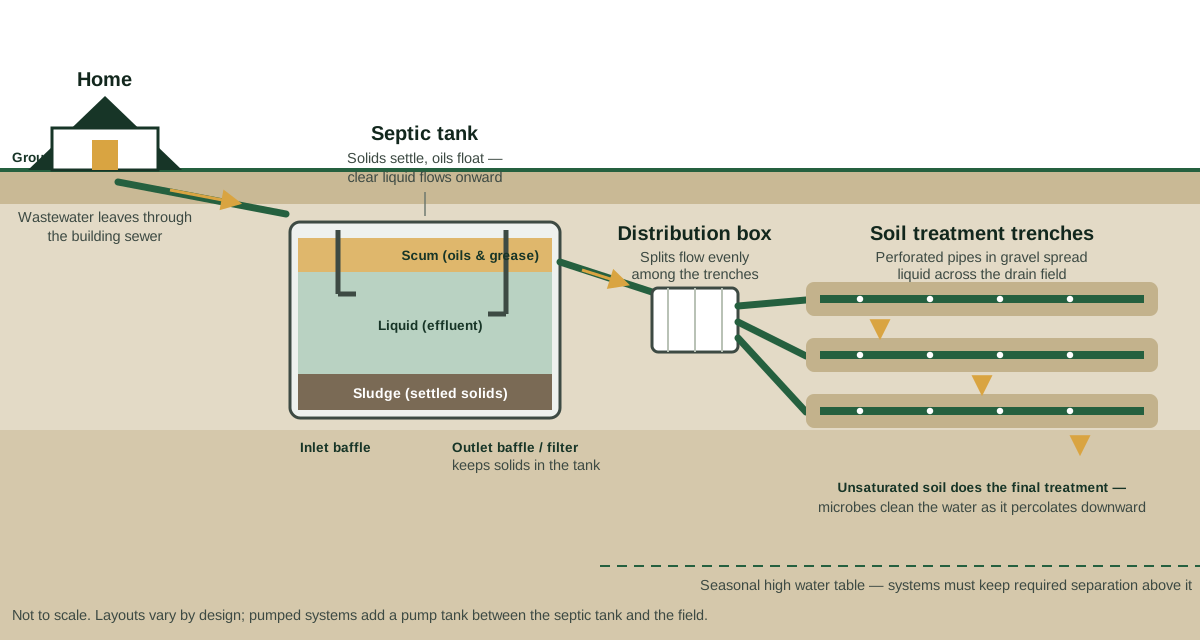
The system you are paying for, in one picture
Before the section-by-section detail, here is the whole job in one picture. Everything an installer builds — tank, distribution, and trenches — exists to move wastewater through these three stages without any of it reaching groundwater untreated.
Signs you may need this service
- You are building a new home on a lot without municipal sewer
- You are splitting or developing land and must prove each lot can support a system
- A lender or county requires proof of a primary and alternate septic site
- Your building permit is waiting on an approved septic design
- An old system on a purchased property must be replaced before the home can be built or occupied
Any one of these is a reason to get a licensed professional on site. Septic problems rarely fix themselves, and the cheapest time to deal with one is before it becomes a backup, a failed inspection, or a closing condition.
How the project runs
- Site evaluation. A certified evaluator looks at your lot, locates setbacks from wells, water, and buildings, and digs soil borings to find suitable treatment area.
- Design. A certified designer sizes the system to your home and soils and produces the drawings and specifications the county permit requires.
- Permit. The design is submitted to Scott County or Dakota County (or your city, where it administers the program) and a construction permit is issued.
- Installation. A licensed installer builds the system to the approved design, with county inspection of the work before it is covered.
- County inspection and records. The finished system is inspected, as-built records are filed, and you receive the documentation future buyers and permit applications will ask for.
Cost snapshot
A conventional in-ground system on cooperative soil is the least expensive path, typically $10,000 to $25,000 installed. Where soils or water table force a mound, expect roughly $25,000 to $45,000, and advanced treatment designs can exceed $50,000. Design and permit fees sit on top of construction on some projects and inside the quote on others, so ask for an itemized number.
| Planning range | What drives it |
|---|---|
| $10,000 – $50,000+ | Soil type and water table, system size and type, tank and pump requirements, lot access, permit and design fees |
Where we match this service
Elko New Market
Septic projects across the city outskirts and surrounding Scott County township acreage.
New Prague
Septic projects on the fringe of New Prague and in its surrounding townships, in both Scott and Le Sueur Counties.
Questions about septic system installation
How long does a new septic installation take?
The digging itself usually takes two to five days once a crew is on site. The longer part is everything before it: site evaluation, design, and county permitting commonly take several weeks, and installer schedules in Scott and Dakota Counties fill quickly in spring and fall. Plan on roughly four to ten weeks from first call to finished system, and start earlier if a home construction schedule depends on it.
What size system does my home need?
Minnesota sizes residential systems primarily by bedroom count, because bedrooms predict water use better than bathrooms or square footage. A certified designer confirms the size after a site evaluation and also checks garbage disposals, water-using appliances, and any home business use. Oversizing wastes money; undersizing risks early failure and permit problems when you add a bedroom later.
Can I install a septic system myself?
In Dakota County, no — Ordinance 113 does not allow homeowner-installed systems, and everyone performing septic work must hold the appropriate MPCA license. In Scott County, owner-installed work has historically been possible only under county permit conditions with added inspection, but design still requires a certified designer. Given the cost of redoing buried work, most owners hire a licensed installer even where an exception exists.
Do I need a perc test?
Modern Minnesota practice relies on soil borings and soil evaluation by a certified site evaluator rather than the old percolation test alone. The evaluator examines soil texture, structure, and the depth to seasonal high water or bedrock. Those findings decide whether a conventional system works or a mound or advanced system is required, so this step cannot be skipped or faked.
What permits are involved?
A county (or administering city) SSTS construction permit is required before installation, based on an approved design. Scott County permit fees for a residential system installed by a licensed installer have been published in the county fee schedule, and Dakota County charges by system type; your installer or designer will confirm the current fee for your address. Building permits for the home are separate.
Can I live in the house during installation?
Yes, in almost all cases. Crews work outside, and the only disruptions are a short window when the connection is switched to the new system and water use should pause, plus a yard that looks like a construction site until final grading. Your installer will flag the switch-over timing in advance so laundry and showers can be planned around it. Keep children and pets clear of open excavations, which are typically open for a day or two at most.
Request a free septic system installation quote
Scott County Septic is a matching service, not a contractor. Your request goes to one independent, MPCA-licensed local installer — never to a call list.
Request received — thank you.
Your matched installer will review your details and contact you about next steps.